Two teams, one operation - see how warehouse and customs agency work together
How do we effectively combine the work of a warehouse and a customs agency? Watch the recording of our webinar and learn about specific solutions.
What was the webinar about?
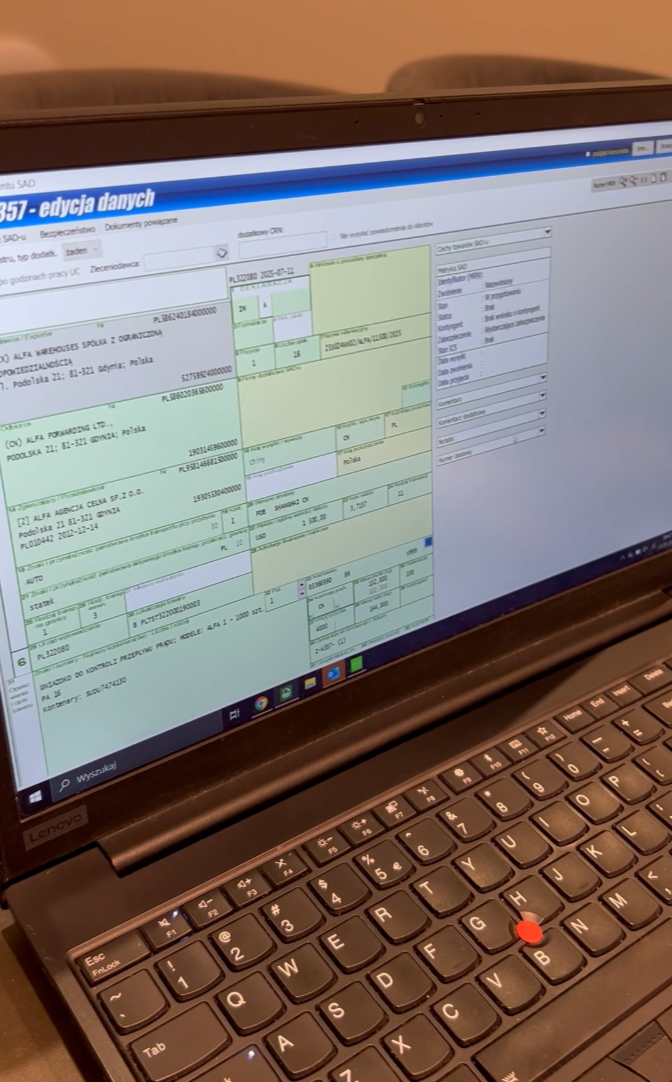
We showed how the warehouse and the customs agency work together on one logistics operation and how they respond together to the daily challenges.
Five situations from everyday work discussed in the webinar
Transshipments
direct
Procedures
repairs
Composition
accurate
Location
recognised
Customs checks
in stock
How does the warehouse and customs agency work together in practice?
During the webinar, we showed how the cooperation between the warehouse and the customs agency works in practice - with concrete examples from everyday work. See how good organisation and communication between teams affects the time, cost and safety of operations.
Watch the recording of the webinar
Watch the full recording of the webinar and learn about specific solutions that improve the collaboration between warehouse and customs agency.
Questions after the webinar
Many practical questions arose during the webinar. We have collected them and prepared our experts' answers.
Yesterday the customs officer sealing the cars skipped our car in the car park, when asked if he could drive to Opłotki to the UC himself - we received a categorical refusal
Customs officers shall carry out sealing only on the basis of closed list of cars, which they receive before starting their activities at the warehouse. Even if new requests arise during their presence, the procedure requires a new list to be generated and officials to be re-deployed.
Key safety principles:
- No arbitrariness: It is strictly forbidden to move the transport itself to the UC for sealing without the express consent and instructions of the Office. Such an action could be considered a violation of the transit procedure.
- Exceptions: Transport without a seal affixed is only possible in emergency situations where the UC officially decides not to apply the seal.
- Procedure: If a car has been missed, the agency must send a new declaration and await another visit from officers or other guidance from the customs authority.
In connection with the introduction of further sensitive goods from 17 March with CN codes, inter alia, 61, 62, and the obligation to declare SENT, the question is: what, in your opinion, should the SENT declaration for imports from China via the terminal in Małaszewicze look like? Is it sufficient to declare SENT200 with the address of the final destination, and then the handling company updates carriers up to the final destination, or is it possible to declare SENT200 for the delivery to the Warehouse, where the goods are unloaded, and then another SENT100 from the Warehouse to the final consignee?
I would suggest 2 SENTs, first SENT 200 (non-Poland/EU goods ) to the warehouse where it will be de-formed, and cleared. Then SENT 100 (EU approved goods shipped from PL )
Can you briefly explain what air customs clearance consists of? What is LRN, official copy and release of goods? And a question - at what point can the customs agency generate an official copy of the customs declaration?
Clearance is based on the number of LRN, which is generated by the customs agency immediately after the declaration is sent to the system and serves to identify the goods before the MRN is assigned. The agency shall make available official (working) copy immediately after obtaining the LRN (at the Welcome terminal this requires an additional e-mail confirmation from UC), and this document is necessary for the driver to take the goods from the warehouse and seal them. Final release of goods and departure from the terminal are only possible after the system has generated document IE029, which completes the transit clearance process.
I have a question regarding SENT, as the owner of the goods (SENT100). Who closes SENT if the consignee has no access to SENT? As the shipper, can I close this SENT or must the carrier do so?
I would close the declaration as shipper, SENT EDIT form and close the declaration with the quantities of goods we have shipped.
Is there any set date for the auditors to arrive at the warehouse to conduct the review?
There is no legally fixed time limit for officers to arrive at the warehouse to carry out searches. In practice, the waiting time depends on the current workload of the Office, staff availability, holidays or the working hours of the officers - usually customs officers appear at the warehouse within one to three days after confirmation of the request.
Is it of real value to a company to have Authorised Economic Operator (AEO) status?
Definitely yes - having AEO status is a real value that allows us, among other things, to secure 30% customs duty and VAT on imports, which is a considerable financial convenience. It makes us a reliable, already verified partner for Customs, which gives us greater ease in obtaining further approvals. AEO status is a process that requires constant contact with the Authority and reporting of any changes, and a rigorous six-monthly audit of all the company's units, which is carried out every three years, confirms the security of our operations.
Can having Binding Tariff Information facilitate customs clearance?
Possession of Binding Tariff Information (WIT) strongly facilitates clearance, as it provides certainty of tariffs and a precise indication of the amount of customs duties. With a BTI, the Customs Office should not verify the correctness of the goods code, as this document is an official confirmation issued by the customs authorities that a product with a given specification must be cleared using a specific tariff code.
Should we add THC and freight to the destination to the import value?
It all depends on the delivery terms that are on the invoice. with the popular FOB freight costs should be added to foreign costs, while THC and transport in the EU/country should be added to domestic costs. In the case of conditions CIF, CFR or DAP foreign costs should already be included in the invoice value of the goods (with CIF and CFR, domestic costs should be accounted for in addition), and with the condition of DAP to a specific location in Poland or the EU, all costs should already be included directly in the invoice value.
What time does a customs officer have to carry out a search of a container in Poland?
There is no predetermined time for the inspection, as it depends on when the terminal (BalticHub, BTC or GTC) inserts the container and the provision of assistance from a customs agency or expert. This timing is also affected by external factors such as weather conditions or holiday periods, which is why, as an agency, we are in constant contact with Customs to determine the exact time of the inspection. A practical tip for importers who regularly import the same goods from the same shipper is to be able to request the UCS to waive a search based on the results of previous inspections from the same month - there is no guarantee of success, but it is worth trying, as there have been situations where the Office has granted such a request.
Can it hold the goods for approximately 14 days, from the time the decision is issued until action is taken? Decision to carry out a search in import (e.g. due to personal shortcomings) (decision to carry out a search)
A situation in which goods are awaiting revision 14 days after the decision has been issued can of course occur. In such a case, we advise you to intervene by email or telephone, or to contact the head of the customs department directly. We are confident that a solution can be found within 2-3 days and we, as the Customs Agency, will be happy to assist you in this.
Do you need support in handling customs or warehousing?
Contact us - we will analyse your operation and suggest the safest and most effective solutions.